
The market is fracturing along a clean line: the US, and everywhere else. Ramp, Mercury, and Limited each play that split differently — and the differences matter more than feature comparisons suggest.
Founders weighing these three platforms are usually choosing between two distinct markets without realizing it. Mercury and Ramp are competing for the US business banking market. Limited is building for global B2B — the ~$150T cross-border market SWIFT moves every year (McKinsey Global Payments). That's roughly 4X the addressable market.
The pace of change isn't where the US incumbents are putting their cycles, either. B2B stablecoin payments grew 733% year-over-year in 2025 (McKinsey x Artemis, Feb 2026). Limited is the only platform of the three with self-custody stablecoin rails built into the bank account — not bolted on top.
Three platforms, three different bets. Here's where each wins.
Ramp — the US spend management heavyweight
$32B valuation, Lightspeed-led, Nov 2025
Spend management: Category-defining corporate cards, AP automation, vendor analytics, real-time policy enforcement.
Accounting: QuickBooks, Xero, NetSuite, and Sage Intacct are all live. Advanced AI workflows (Ramp Intelligence, contract review, automation) are gated to Plus/Pro paid tiers.
Stablecoin engine: USDC + USDT custodial accounts across 7 chains (Base, Ethereum, Polygon, Arbitrum, Optimism, Solana, Tempo). ~3.98% rewards (Mar 2026).
Payments: Free domestic ACH and wires. Up to 3% FX on international card spend.
Eligibility: US-registered entity + US bank account required. Stablecoin product unavailable in NY.
Mercury — the US business banking standard
$3.5B valuation, Sequoia-led, Mar 2025
Banking: $5M FDIC across up to 20 partner banks via Mercury Vault sweep network. Free domestic and USD international wires.
Payments: 1% FX on non-USD wires across 40+ currencies. 3% fee on non-USD card transactions.
Cards: IO charge card with 1.5% cashback. Solid underwriting tied to operating account behavior.
Accounting: QuickBooks + Xero on the free plan. NetSuite locked behind the $35+/mo paid tier.
Stablecoin engine: Not supported.
Eligibility: US-formed entity AND US operations required.
Limited — global business banking, native stablecoin engine
Banking: Receive funds as a multinational with six native rails — US bank account, EU IBAN, Mexican CLABE, Brazilian PIX ID, Nigerian and UAE accounts. Available regardless of where you're incorporated.
Payments: 140+ countries, 80+ currencies, 300+ local rails — SWIFT, ACH, SEPA, PIX, SPEI, WeChat, UPI, GrabPay, MOVII, and more. Instant on-network transfers at zero fee.
Cards: Visa virtual + physical. 1% international card fee — 3X cheaper than Mercury's 3%.
Accounting: QuickBooks live. Xero, NetSuite + 50+ ERP integrations rolling out 2026 with AI-driven GL coding, automated reconciliation, and month-end close.
Stablecoin engine: Native, self-custody — USDC, USDT, EURC across 11 chains. Instant cross-border settlement, not a custodial wrapper bolted onto a US bank.
Eligibility: Any company, anywhere. KYB at the source, no US shell required.
A regulatory note worth flagging
Both Mercury and Ramp accept international founders, but through one path: a US-shell LLC, often with no real US operations. That path has tightened sharply since 2024, as US banking partners faced increased FDIC scrutiny and pulled back from non-US-operated entities. Limited's model goes the other way: real KYB at the source, on infrastructure built for it from day one.
How each platform makes money
The revenue models tell a clearer story than the feature lists.
Ramp runs on interchange and paid-tier SaaS. Volume- and transaction-driven, and exposed to interchange regulation and the next leg of the Durbin debate.
Mercury runs on net interest margin on its $20B deposit base (shared with banking partners), plus interchange and SaaS subscriptions. Deposit-yield-driven and sensitive to Fed cuts and venture liquidity (Sacra, 2025).
Limited runs on a diversified mix: FX margin on cross-border flows, interchange on card spend, premium card subscriptions, and controlled-access yield through native stablecoin rails.
Mercury's economics get harder as rates fall. Ramp's economics are exposed to interchange regulation. Limited's revenue model is the one that compounds when global B2B and stablecoin adoption do.
At a glance
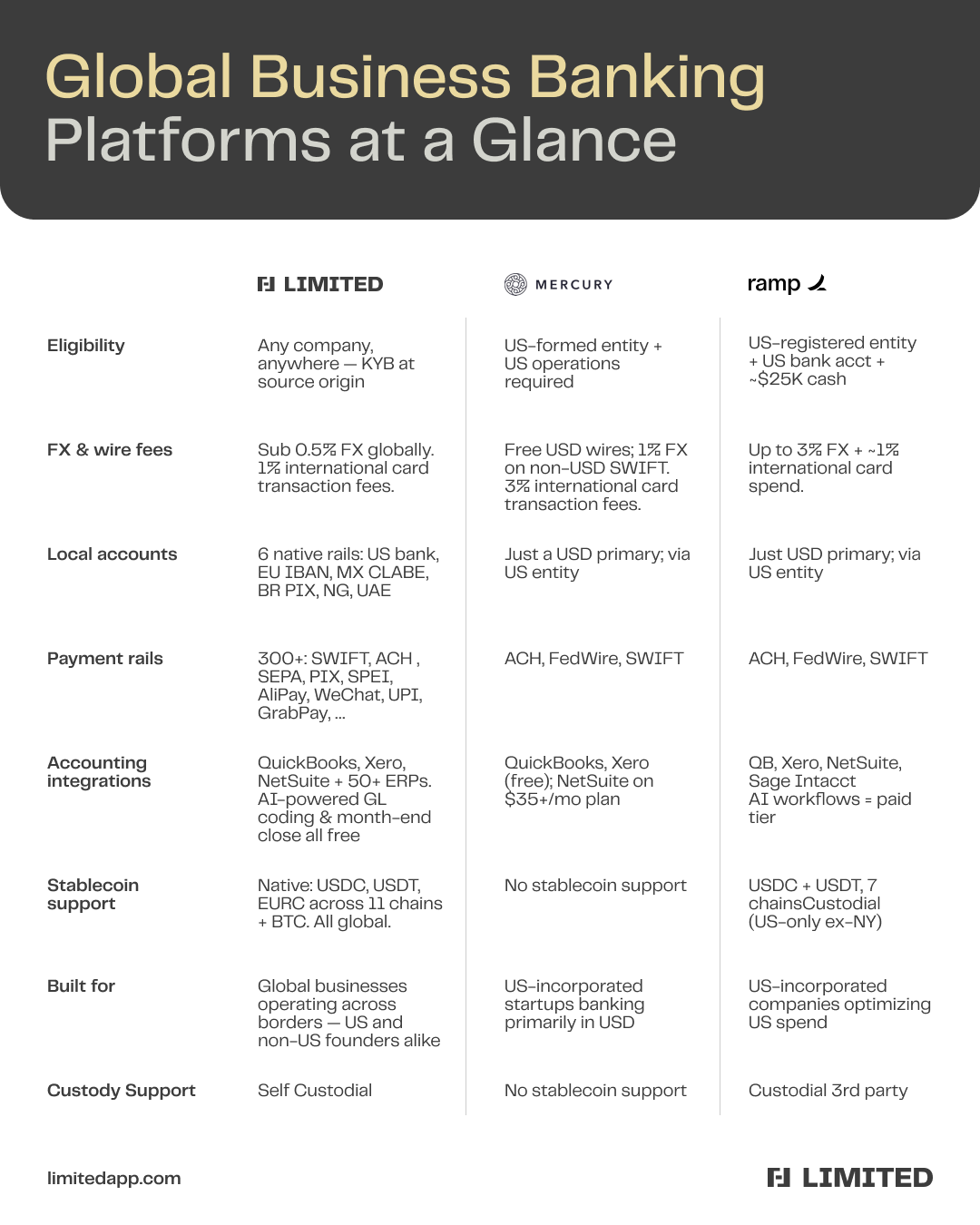
The bottom line
Ramp is the deepest spend management platform on the market — if you can stomach the paywall on its best AI and accounting workflows, and you're already a US company.
Mercury is the cleanest US bank if your operations are USD-primary, your entity is Delaware, and your team operates inside US borders.
Limited is what global business banking looks like when stablecoin rails are built in, not bolted on. Six native receiving rails, 1% card fees, real KYB at the source, native self-custody.
Three players, three different markets, three different revenue models. The next decade of business banking won't be won inside the US. It will be won where the volume actually is: across borders, where SWIFT moves $150T a year and B2B stablecoin payments just grew 7X in twelve months.
Sources
- McKinsey Global Payments — mckinsey.com/industries/financial-services/our-insights/global-payments-report
- Ramp $32B valuation: TechCrunch and PR Newswire, Nov 17, 2025 — techcrunch.com/2025/11/17/ramp-hits-32b-valuation-just-three-months-after-hitting-22-5b/
- Mercury $3.5B valuation, $500M revenue, $20B deposit base: Sacra, "Mercury at $500M annualized revenue," April 2025 — sacra.com/research/mercury-at-500m-annualized-revenue/
- B2B stablecoin payments grew 733% YoY: McKinsey x Artemis Analytics, "Stablecoins in payments: What the raw transaction numbers miss," February 2026 — mckinsey.com/industries/financial-services/our-insights/stablecoins-in-payments-what-the-raw-transaction-numbers-miss
- SWIFT processes ~$150T in cross-border payments annually: McKinsey 2025 Global Payments Report — mckinsey.com/industries/financial-services/our-insights/global-payments-report
- Mercury account closures across 13+ non-US-operated regions, mid-2024: TechCrunch, July 2024 (FDIC scrutiny of partner Choice Bank) — techcrunch.com/2024/07/23/mercury-bank-fintech-sanctions-ukraine-nigeria/
- Mercury, Ramp pricing & eligibility: mercury.com/pricing, mercury.com/security, support.ramp.com (verified April 2026)